

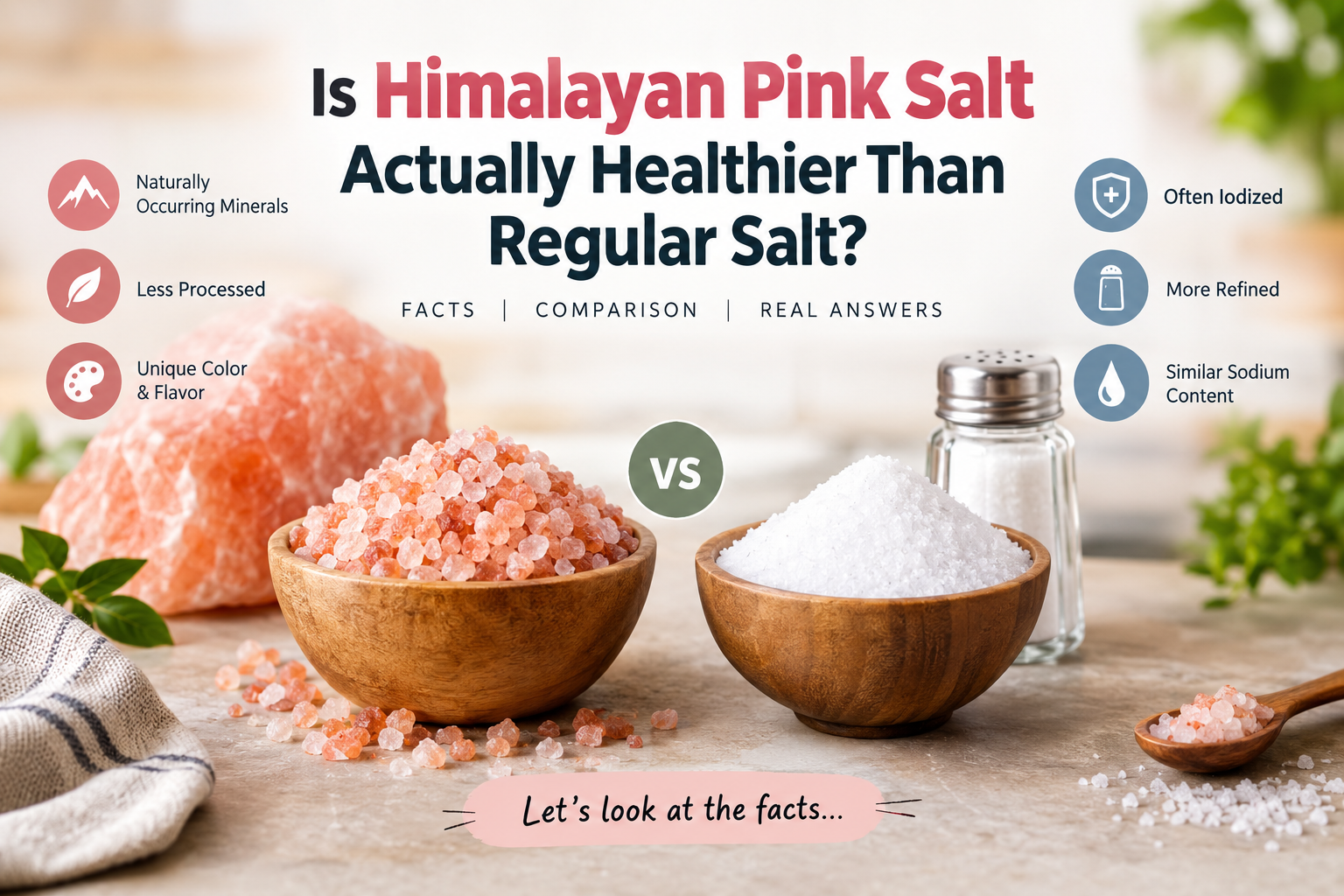
Himalayan pink salt has become a popular alternative to regular table salt in kitchens across the United States. Its natural pink color, mineral content, and “less processed” reputation have led many people to believe that it is a healthier choice.
But is Himalayan pink salt actually healthier than regular salt?
The short answer is: not necessarily. Himalayan pink salt contains small amounts of naturally occurring minerals and is generally less processed than table salt, but both types of salt are primarily sodium chloride. The trace minerals in pink salt are present in such small amounts that they do not provide a meaningful nutritional advantage under normal dietary use.
One important difference is that regular table salt is often iodized, while Himalayan pink salt is usually not. That can make iodized salt a useful source of iodine for people who need it.
For most people, the most important factor for health is not whether salt is pink or white—it is how much sodium is consumed overall.
Himalayan Pink Salt vs. Regular Salt: Quick Comparison
| Feature | Himalayan Pink Salt | Regular Table Salt |
| Main component | Sodium chloride | Sodium chloride |
| Color | Pink to reddish | White |
| Processing | Generally minimally processed | More highly refined |
| Trace minerals | Small amounts | Most naturally occurring minerals removed |
| Iodine | Usually not a reliable source | Often iodized |
| Sodium | Similar overall | Similar overall |
| Proven major health advantage | No | No |
| Common uses | Cooking, seasoning, finishing | Cooking, baking, seasoning |
The biggest nutritional takeaway is simple: switching from table salt to Himalayan pink salt does not automatically make a high-sodium diet healthier.
What Is Himalayan Pink Salt?
Himalayan pink salt is a type of rock salt mined from salt deposits in Pakistan’s Punjab region. Its characteristic pink color comes from naturally occurring trace minerals and compounds, including iron.
Unlike highly refined table salt, Himalayan pink salt is generally processed less extensively. Depending on the product, it may be sold as fine grains, coarse crystals, flakes, or chunks.
Its distinctive appearance and texture make it popular for cooking, seasoning, salt grinders, and finishing dishes.
However, being less processed does not automatically mean a food is nutritionally superior.
Why Is Himalayan Pink Salt Pink?
The pink color comes from naturally occurring trace substances in the salt, particularly iron-containing compounds.
The color can range from very pale pink to deeper pink or reddish shades depending on the mineral composition and source.
But a more colorful salt is not necessarily a healthier salt. The mineral concentrations responsible for the color are generally too small to provide significant nutritional benefits when consumed in normal amounts.
Does Himalayan Pink Salt Have More Minerals?
Yes. Himalayan pink salt can contain trace amounts of minerals that are largely removed during the refining of conventional table salt.
Which minerals are found in Himalayan pink salt?
Calcium
Magnesium
Potassium
Iron
Other trace elements
However, this is where health marketing can become misleading. The quantities are generally too small to make Himalayan salt a meaningful mineral source during normal dietary use.
If your goal is to increase magnesium, potassium, calcium, or iron intake, nutrient-rich foods are much more practical sources.
Is Himalayan Pink Salt Lower in Sodium?
Himalayan pink salt and table salt have similar sodium content by weight because both are primarily sodium chloride.
Some comparisons may show a different sodium amount per teaspoon because crystal size and density vary. A teaspoon of coarse salt can contain less salt by weight than a teaspoon of fine table salt.
That does not mean Himalayan pink salt is inherently low-sodium.
What matters most?
If you switch from regular salt to pink salt but continue using the same amount, you should not expect a major reduction in sodium intake. The bigger health improvement comes from reducing total sodium intake.
Himalayan Pink Salt and Iodine: An Important Difference
Iodine is an essential nutrient that your body needs to make thyroid hormones.
This is one area where regular iodized table salt can have an advantage. In the United States, table salt is commonly available in iodized forms, while Himalayan pink salt is generally not a reliable source of iodine.
Replacing iodized salt with non-iodized salt without getting enough iodine from other foods could reduce iodine intake.
Why iodine matters
People who rely on iodized salt as an iodine source should consider their overall dietary iodine intake before switching completely to non-iodized salt. If iodine is a concern, speak with a healthcare professional or registered dietitian.
Is Himalayan Pink Salt Better for Blood Pressure?
No salt should be considered a blood-pressure-lowering food.
The important factor is total sodium intake. Switching salt varieties does not eliminate the effects of excessive sodium consumption.
For people trying to manage blood pressure, reducing sodium intake overall is much more important than choosing pink salt over white salt.
How Much Sodium Should You Have Per Day?
For adults and teenagers age 14 and older, U.S. dietary guidance recommends no more than 2,300 milligrams of sodium per day.
That limit includes sodium from all foods and beverages—not just the salt added during cooking.
Processed foods, packaged meals, restaurant foods, sauces, and snacks can contribute substantial amounts of sodium.
A better question to ask
Instead of asking only, “Should I use Himalayan salt or table salt?” ask: “How much total sodium am I getting throughout the day?”
What Are the Real Benefits of Himalayan Pink Salt?
Himalayan pink salt is not a miracle health food, but it can have practical culinary advantages.
1. Distinctive appearance
Its natural pink color can make food look more appealing, especially when used as a finishing salt.
2. Different texture
Coarse Himalayan salt can provide a different crunch and mouthfeel compared with finely ground table salt.
3. Distinct flavor
Some people prefer the flavor profile of Himalayan pink salt, particularly when used as a finishing seasoning.
4. Less processing
People who prefer minimally processed ingredients may choose Himalayan pink salt because it generally undergoes less refining than conventional table salt.
5. Versatile culinary use
Depending on the grain size, Himalayan salt can be used in cooking, seasoning, salt grinders, marinades, and finishing dishes.
What About the Health Claims Surrounding Pink Salt?
Himalayan salt is sometimes promoted for detoxification, better hydration, weight loss, improved sleep, balancing body pH, better digestion, lower blood pressure, replacing electrolytes, and removing toxins.
These claims should be approached carefully. There is not strong evidence that ordinary dietary use of Himalayan pink salt produces these special health effects.
Pink salt should be viewed primarily as a seasoning, not a health treatment.
Is Himalayan Pink Salt Healthier Than Regular Salt?
The most accurate answer is: Himalayan pink salt is not proven to be significantly healthier than regular table salt.
It is usually less processed, contains trace minerals, has a distinctive pink color, has a different texture and flavor, and is usually not iodized. But these differences do not translate into a major health advantage.
Regular iodized table salt also has an important benefit: it can provide iodine, an essential nutrient.
For most people, choose the salt you enjoy, watch your portion size, and pay attention to total daily sodium intake.
Which Salt Should You Choose?
Choose Himalayan pink salt if:
You enjoy its taste or texture.
You prefer minimally processed salt.
You like its natural pink appearance.
You want a salt suitable for a grinder or finishing.
You understand that it is still a source of sodium.
Choose iodized table salt if:
You want a convenient source of iodine.
You prefer fine salt for cooking or baking.
You want an affordable everyday salt.
Your diet may otherwise provide limited iodine.
Most importantly
Whichever salt you choose, use it in moderation.
Himalayan Pink Salt vs. Regular Salt: The Bottom Line
Himalayan pink salt is a popular and visually distinctive seasoning, but it should not be considered a nutritional superfood.
It contains trace minerals, but those minerals occur in quantities too small to provide meaningful nutritional benefits during normal use. Both Himalayan pink salt and regular table salt provide sodium, so neither should be used excessively.
The biggest nutritional difference may actually be iodine. Regular table salt is often iodized, while Himalayan pink salt generally is not.
For most people, the best approach is simple: choose the salt you enjoy, watch your portion size, and pay attention to your total daily sodium intake.
Frequently Asked Questions
Is Himalayan pink salt healthier than regular table salt?
Not in any major proven nutritional way. Both are primarily sodium chloride. Himalayan salt contains trace minerals, but they are present in amounts too small to provide significant health benefits under normal use.
Is Himalayan pink salt better for high blood pressure?
No. Himalayan pink salt still contains substantial sodium. People managing blood pressure should focus on reducing overall sodium intake rather than assuming pink salt is a low-sodium alternative.
Does Himalayan pink salt contain iodine?
Himalayan pink salt is generally not a reliable source of iodine. Many regular table salts are iodized, making them a more predictable dietary source of iodine.
Does Himalayan pink salt have less sodium than table salt?
The sodium content is broadly similar by weight. Differences per teaspoon can occur because Himalayan salt crystals may be larger or less dense than fine table salt.
Does Himalayan pink salt contain more minerals?
Yes, it can contain more naturally occurring trace minerals than refined table salt. However, the quantities are generally too small to make it a meaningful mineral source.
Can I use Himalayan pink salt for everyday cooking?
Yes. Himalayan pink salt can be used for cooking, seasoning, baking, finishing dishes, and in salt grinders. Use it in moderation just as you would other types of salt.
Is Himalayan pink salt good for weight loss?
There is no good evidence that Himalayan pink salt itself causes weight loss or increases fat burning.
Is Himalayan pink salt good for hydration?
Pink salt contains sodium, which is an electrolyte, but adding extra salt to your diet is not automatically a better hydration strategy.
Is Himalayan pink salt natural?
Himalayan pink salt is generally less processed than conventional refined table salt and retains naturally occurring minerals that contribute to its color. However, “natural” does not automatically mean healthier.
Conclusion
Himalayan pink salt can be a great culinary ingredient, but it is not a magic health food.
If you love the color, flavor, texture, or minimally processed nature of Himalayan pink salt, you can use it in your kitchen. Just remember that it is still salt—and therefore still a significant source of sodium.
For better health, focus less on whether your salt is pink or white and more on your overall sodium intake, food choices, and dietary pattern.
This article is for general educational purposes and is not a substitute for personalized medical or nutrition advice.